Παρασκευή, Απριλίου 08, 2011

Makoto Aida - Κάτω από τον ατομικό εφιάλτη


Μαθήτριες που τις βιάζουν θαλάσσια τέρατα τα οποία μοιάζουν λες και βγήκαν από τα βάθη του ωκεανού μετά την καταστροφή της Φουκουσίμα. Νεαρά κορίτσια που κάνουν χαρακίρι με σπαθιά σαμουράι, γιαπωνέζικα βομβαρδιστικά που εφορμούν για να τυλίξουν το Μανχάταν στις φλόγες, σαρδώνια κοινωνικά σχόλια, μηδενιστικά μηνύματα και ένας υφέρπων θυμός που είναι έτοιμος να χτυπήσει σαν τσουνάμι τις αισθήσεις του θεατή είναι μερικά μόνο από τα στοιχεία που κυριαρχούν στον εφιαλτικό κόσμο του Μακότο Αίντα (Makoto Aida).


Πρόκειται για έναν μεγάλο καλλιτέχνη που προκαλεί τον θεατή να τον μισήσει, ενώ ταυτόχρονα μαγνητίζει το βλέμμα και το υποσυνείδητό του. Μετά τον 2ο Παγκόσμιο Πόλεμο οι ιάπωνες βλέποντας με τρόμο την ταπεινωτική ήττα του στρατού τους να οδηγεί στην τραγωδία της Χιροσίμα, αποφάσισαν να κάνουν μια σημαντική στροφή και από μια μιλιταριστική κοινωνία να στραφούν προς μια κοινωνία καταναλωτική, όπου οι ρυθμοί ανάπτυξης ήταν το νέο εθνικό σύμβολο.

Το μοντέλο αυτό όχι μόνο απέτυχε να κάνει τους ιάπωνες ευτυχισμένους - γεγονός που αποδεικνύεται από την κατάρρευση των γάμων και της γονιμότητας και τα συνεχώς αυξανόμενα ποσοστά αυτοκτονιών-, αλλά κατέληξε και σε έναν εφιάλτη σκεπασμένο από ραδιενεργό νέφος, σχεδόν πανομοιότυπο με εκείνο του Ναγκασάκι.


Την αποτυχία αυτή εκφράζει ο Αίντα μέσα από τις ζοφερές εικόνες τους που θυμίζουν Ιερώνυμο Μπος με σχιστά μάτια. Την ίδια στιγμή, όπως όλοι οι μεγάλοι καλλιτέχνες κάνει αναφορές στους μαέστρους του παρελθόντος. Το έργο του «No More War. Save Water. Don’t Pollute The Sea», όπου ένα θαλάσσιο τέρας συνουσιάζεται με μια νεαρή μαθήτρια, είναι σαφής αναφορά στο διάσημο έργο του Hokusai «Το όνειρο της γυναίκας του ψαρά» όπου μια γυναίκα φαίνεται να βρίσκει την ηδονή με δύο χταπόδια.


...

Πέμπτη, Απριλίου 07, 2011

Ιωάννης Αλταμούρας - Το ιερό φως

Ο Ιωάννης Αλταμούρας μπορεί να γεννήθηκε στη Φλωρεντία ή τη Νάπολη της Ιταλίας το 1852 και πέθανε στις Σπέτσες τον Μάιο του 1878. Ήταν γιος του ιταλού ζωγράφου και επαναστάστη Φραντσέσκο Σαβέριο Αλταμούρα (Francesco Saverio Altamura) και της Ελένης Μπούκουρα – Αλταμούρα, που καταγόταν από αρχοντική οικογένεια των Σπετσών. Η μητέρα του ήταν η πρώτη ελληνίδα ζωγράφος και δίδαξε την τέχνη του σχεδίου στον Ιωάννη, που από μικρός έδειξε την έμφυτη κλίση του προς την ζωγραφική. Έγινε δεκτός στην Σχολή των Τεχνών (την μετέπειτα «Ανωτάτη Σχολή Καλών Τεχνών» της Αθήνας), όπου μελέτησε ζωγραφική κοντά στον Νικηφόρο Λύτρα κατά την διετία 1871 - 1872. Με υποτροφία του Βασιλιά Γεωργίου Α΄, συνέχισε τις σπουδές του στην Κοπεγχάγη κατά την περίοδο 1873 -1876 κοντά στον Καρλ Φρέντερικ Σόρενσεν (Carl Frederik Sørensen). Το 1875, και ενώ βρίσκονταν ακόμα στην Κοπεγχάγη, έστειλε στην έκθεση των Ολυμπίων στην Αθήνα το έργο του «Το λιμάνι της Κοπεγχάγης», για το οποίο τιμήθηκε με αργυρό μετάλλιο Β΄ τάξεως. Όταν επέστρεψε στην Ελλάδα, άνοιξε εργαστήριο ζωγραφικής στην Αθήνα, ενώ η φήμη του άρχισε να αυξάνεται. Δυστυχώς, προσβλήθηκε από φυματίωση και πέθανε το 1878, σε ηλικία μόνον 26 ετών. Ο θάνατός του και ο θάνατος της αδελφής του, που είχε συμβεί λίγα χρόνια πριν — επίσης από φυματίωση — οδήγησε την μητέρα του στον νευρικό κλονισμό και την τρέλα.

Το έργο του Ο πρόωρος θάνατός του είχε σαν αποτέλεσμα να αφήσει πίσω του λίγα έργα. Μόνα να φανταστεί μπορεί κανείς το τι θα μπορούσε να δημιουργήσει πάνω στον κομβά ο Αλταμούρας, αν είχε τη δυνατότητα να μεγαλώσει και να ωριμάσει η τεχνική του και το ταλέντο του. Όμως οι λίγοι πίνακες που άφησε μαρτυρούν ένα με γάλο ταλέντο, τουλάχιστον ισάξιο του άλλου μεγάλου έλληνα θαλασσογράφου του 19ου αι., του Κωνσταντίνου Βολανάκη. Το 1878, χρονιά του θανάτου του, δύο πολεμικές θαλασσογραφίες του - η «Πυρπόληση της πρώτης οθωμανικής φρεγάτας στην Ερεσό από τον Παπανικολή» και η «Ναυμαχία του ναυάρχου Μιαούλη εναντίον δύο οθωμανικών φρεγατών στην είσοδο της Πάτρας» - παρουσιάστηκαν στην Διεθνή Έκθεση του Παρισιού. Ο δεύτερος πίνακας παρουσιάστηκε και στην Έκθεση Μνημείων του Ιερού Αγώνα στο Πολυτεχνείο της Αθήνας το 1884. Τέλος, μία θαλασσογραφία του παρουσιάστηκε στην Διεθνή Έκθεση της Ρώμης το 1911. Αν και οι ιστορικοί τέχνης τον κατατάσσουν στην ακαδημαϊκή «Σχολή του Μονάχου», εντούτοις η φωτεινότητα των έργων του και η κίνηση του πινέλου δείχνουν ότι ο Αλταμούρας είχε αρχίσει να ξεπερνάει την αυστηρή τελειότητα του ακαδημαϊσμού και να στρέφεται προς τον ιμπρεσιονισμό.

Πήγα πριν λίγες ημέρες στην έκθεση που γίνεται στο Μουσείο Μπενάκη στην Πειραιώς και σας συμβουλεύω να την επισκεφτείτε, όσοι τουλάχιστον από εσάς ενδιαφέρονται για τη ζωγραφική.

Τετάρτη, Απριλίου 06, 2011

Τρίτη, Απριλίου 05, 2011

τα πρόσωπα της πλατείας Ταχρίρ


Φωτό : Micah Garen

.

Tina Fay : Το ερωτηματολόγιο του Προυστ


What is your current state of mind?

On the verge of nervous exhaustion, but only for the last seven years.

What is your idea of perfect happiness?

A glass of wine at sunset on Fire Island. / No homework.

What is your greatest fear?

Child, loss or damage thereof.

Which historical figure do you most identify with?

Catherine the Great’s horse.

Which living person do you most admire?

Cathy Rigby. She was really good in that stage version of Peter Pan. No joke.

What is the trait you most deplore in yourself?

Procrastination.

What is the trait you most deplore in others?

People who are proud of their ignorance.

What is it that you most dislike?

People who mock education as elitist.

What is your greatest extravagance?

Living in New York City.

What do you most value in your friends?

A willingness to come uptown.

What is your favorite journey?

Pulling up to my parents’ house for Christmas. Just pulling up, though—not the whole drive.

What is your most treasured possession?

A photo of my parents walking around the Acropolis circa 1965. They look like a poster for Two for the Road.

What do you consider the most overrated virtue?

Natural childbirth.

On what occasion do you lie?

During press junkets for movies.

Which living person do you most despise?

Osama bin Laden. Unless we think he’s dead by now, in which case that guy who holds up the GOD HATES FAGS sign.

What or who is the greatest love of your life?

Jeff and Alice Richmond equally, but only because they look exactly alike.

When and where were you happiest?

Anywhere, during the 2 to 24 hours after a successful joke.

If you could change one thing about yourself, what would it be?

I would get 30 hours a day when everyone else gets 24.

What do you consider your greatest achievement?

Providing 200 people with a nice place to work.

If you could change one thing about your family, what would it be?

My husband and I would work less and my daughter would sleep more.

What do you regard as the lowest depth of misery?

September 12, 2001.

What is your favorite occupation?

Being between jobs but having a good one lined up in about a month or so.

What is your most marked characteristic?

Obedience and a long nose. (I might be a collie.)

Who is your favorite hero of fiction?

Veruca Salt, Francie Nolan, Miss Havisham. That’s me in a nutshell, actually.

How would you like to die?

I would like to drop dead while introducing the “In Memoriam” clip package at the Emmys … on my 10,000th birthday.

What is your motto?

“Stop reaching for the stars!”

τα φετινά λουλούδια


από το μπαλκόνι μου στις οθόνες σας ...

.

Σάββατο, Απριλίου 02, 2011

Παρασκευή, Απριλίου 01, 2011

the art of Albert York


Θαυμάζοντας τα κύματα 3


Τα ρεύματα είναι τα πιο μεγαλειώδη φαινόμενα των ωκεανών. Η περιστροφή της Γης γύρω από τον άξονά της, οι άνεμοι που ανταριάζουν τις θάλασσες και η επίδραση της Σελήνης και του Ήλιου είναι δυνάμεις αλληλένδετες με τα μεγάλα ρεύματα των ωκεανών που γι αυτό τον λόγο αποκαλούνται «πλανητικά ρεύματα».

Από την αρχή του κόσμου τα ωκεάνεια ρεύματα έχουν αλλάξει πολλές φορές την πορεία τους. Γνωρίζουμε για παράδειγμα ότι το Ρεύμα του Κόλπου έχει ηλικία περίπου 60 εκατ. χρόνια. Είναι αδύνατο να φανταστούμε την πορεία τους στην Κάμβρια περίοδο ή στην Ιουράσια. Παρ όλα αυτά στη σύντομη περίοδο της ανθρώπινης ιστορίας είναι απίθανο να έχουν υπάρξει σημαντικές αλλαγές στην πορεία των ρευμάτων. Αυτό δεν πρέπει να μας προκαλεί εντύπωση δεδομένου ότι τα ρεύματα δεν έχουν παρουσιάσει σημαντικές αλλαγές μέσα στους αιώνες της ιστορίας των ανθρώπων. Η βασική κινητήρια δύναμη είναι οι άνεμοι και οι δυνάμεις που επιδρούν στη διαμόρφωση της πορεία τους είναι ο Ήλιος, η περιστροφή της Γης προς τα ανατολικά και οι μάζες των ηπείρων.

Καθώς η επιφάνεια των ωκεανών θερμαίνεται από τον ήλιο το νερό διαστέλεται και γίνεται ελαφρύτερο. Τα θερμά ύδατα των τροπικών στα ανώτερα στρώματα κατευθύνονται προς τους πόλους και τα βαρύτερα ύδατα από τους πόλους βυθίζονται και κατευθύνονται προς τους τροπικούς στα βάθη των θαλασσών. Όμως σε αυτές τις κινήσεις επιδρά η πολύ μεγαλύτερη δύναμη του ανέμου. Οι πιο σταθεροί άνεμοι είναι αυτοί που πνέουν διαγώνια προς τον ισημερινό από τα βορειοανατολικά και τα νοτιοανατολικά. Είναι αυτοί οι άνεμοι που κινούν τα ισημερινά ρεύματα γύρω από τον πλανήτη, με κατεύθυνση πάντα προς τα δυτικά. Αλλά και η περιστροφή της Γης εξασκεί μια επίδραση και όταν τα ισημερινά ρεύματα συναντούν στον δρόμο τους τις ηπείρους στρέφονται στο βόρειο ημισφαίριο προς τα δεξιά και στο νότιο προς τα αριστερά. Εξ αιτίας του συνδυασμού αυτών και άλλων δυνάμεων η πορεία των ρευμάτων θυμίζει στροβίλους με κατεύθυνση προς τα δεξιά ή σύμφωνα με τους δείκτες του ρολογιού στους βόρειους ωκεανούς και αντίθετη στους νότιους.

Είναι φυσικά στον Ατλαντικό και τον Ειρηνικό που μπορεί κανείς να δει τη διαδραστικότητα των δυνάμεων που δημιουργούν τα πλανητικά ρεύματα. Επειδή ίσως για πολλούς αιώνες τα πλοία διασχίζουν τον Ατλαντικό τα ρεύματά του είναι πιο γνωστά στους ναυτικούς και τους ωκεανογράφους. Η πρώτη καταγραφή του ρεύματος του Κόλπου έγινε το 1769 υπό την εποπτεία του Βενιαμίν Φρανκλίνου. Το τελωνειακό γραφείο στη Βοστώνη παραπονέθηκε ότι το ταχυδρομείο από τη Βρετανία έκανε δύο εβδομάδες περισσότερο να φτάσει στις αποικίες, απ όσο χρειάζοταν να πλοία από την Αμερική να φτάσουν στη Βρετανία. Ο Φρανγκλίνος παραξενεύτηκε και συζήτησε το ζήτημα με έναν φαλαινοθήρα από το Ναντάκετ, τον Τίμοθι Φόλγκερ, ο οποίος του είπε ότι οι αμερικανοί καπετάνιοι γνώριζαν καλύτερα το ρεύμα του Κόλπου κι έτσι μπορούσαν να το αποφεύγουν πλέοντας προς τα ανατολικά. Ο Φρανγκλίνος ζήτησε από τον Φόλγκερ να το καταγράψει πάνω σε έναν χάρτη τον οποίο έστειλε στη Βρετανία. Αλλά οι βρετανοί καπετάνιοι απλά τον κορόιδευσαν.

Αυτός ο «ποταμός» μέσα στη θάλασσα έχει πλάτος 95 μίλια, βάθος ένα μίλι και κινείται με ταχύτητα τριών κόμβων.

συνεχίζεται ...

Πέμπτη, Μαρτίου 31, 2011

Τετάρτη, Μαρτίου 30, 2011

more art


για να δούμε και κάτι ευχάριστο

...

ΣΗΜΕΡΑ ΧΑΙΡΟΜΑΙ ΠΑΡΑ ΠΟΛΥ

...


ΓΙΑΤΙ ΑΝΑΚΑΛΥΨΑ ΟΤΙ ΕΚΤΟΣ ΑΠΟ BLOGGER ΕΙΜΑΙ ΚΑΙ ΕΚΔΟΤΙΚΟΣ ΟΙΚΟΣ


...

ΤΕΛΙΚΆ ΔΕΝ ΥΠΑΡΧΕΙ ΝΤΡΟΠΗ ΣΕ ΑΥΤΟΝ ΤΟΝ ΚΟΣΜΟ

...

art by Mark Morrisroe


Τρίτη, Μαρτίου 29, 2011

art by Jeremy Kost

γειά σας είμαι η Fukushima Funtosi


Michael Collins [1]

According to an international scientific group monitoring radiation around the world, the Fukushima reactors are emitting nuclear toxins at levels approaching those seen in the "aftermath" of Chernobyl. The Chernobyl disaster began with an explosion, Fukushima is a smoldering cauldron of toxins. Chernobyl had 180 tonnes of nuclear fuel on site. Fukushima has 1700 tonnes of nuclear fuel on site. (Image [2])

This isn't the beginning of the end as hoped, it's looking like the end of the beginning.

CounterPunch ran an interview wit Japanese nuclear industry author Hiroshe Takashi just yesterday in which the author lamented the poor reporting of the tragedy in the Japanese press:

"Really, they talk this nonsense, trying to reassure everyone, trying to avoid panic. What we need now is a proper panic. Because the situation has come to the point where the danger is real." Hiroshe Takashi, March 22 [3]

Just two days later, the "proper panic" is on its way.

The Central Institute for Meteorology and Geodynamics [4] of Vienna, Austria has a world wide monitoring system set up to monitor the Comprehensive Test Ban Treaty. They are well positioned to monitor the effects of the Fukishima disaster.

The group told New Scientist that:

Japan's damaged nuclear plant in Fukushima has been emitting radioactive iodine and caesium at levels approaching those seen in the aftermath of the Chernobyl accident [5] in 1986. Austrian researchers have used a worldwide network of radiation detectors – designed to spot clandestine nuclear bomb tests – to show that iodine-131 is being released at daily levels 73 per cent of those seen after the 1986 disaster. The daily amount of caesium-137 released from Fukushima Daiichi is around 60 per cent of the amount released from Chernobyl. New Scientist, March 24 [6]

The concerns about spent fuel rods and cooling polls in the reactor have materialized. The Chernobyl event was more discrete and identifiable with a major explosion but damaged reactors at Fukushima are toxic nonetheless. The Austrian scientists point out that Chernobyl had 180 tons of nuclear on hand while Fukushima has nearly ten times that amount at 1700 tons.

"When the fuel is damaged there is no reason for the volatile elements not to escape," and the measured casium and iodine are in the right ratios for the fuel used by the Fukushima Daiichi reactors. Also, the Fukushima plant has around 1760 tonnes of fresh and used nuclear fuel on site [7], and an unknown amount has been damaged. The Chernobyl reactor had only 180 tonnes. New Scientist, March 24 [8]

In his interview on the 22nd, Takashi was blunt about the health risks. He distinguished between radiation in the atmosphere and radioactive particles carried in the atmosphere, then ingested into the body.

Yoh: So making comparisons with X-rays and CT scans has no meaning. Because you can breathe in radioactive material.

Hirose: That’s right. When it enters your body, there’s no telling where it will go. The biggest danger is women, especially pregnant women, and little children. Now they’re talking about iodine and cesium, but that’s only part of it, they’re not using the proper detection instruments. What they call monitoring means only measuring the amount of radiation in the air. Their instruments don’t eat. What they measure has no connection with the amount of radioactive material. . . .

Yoh: So damage from radioactive rays and damage from radioactive material are not the same.

Hirose: If you ask, are any radioactive rays from the Fukushima Nuclear Station here in this studio, the answer will be no. But radioactive particles are carried here by the air. When the core begins to melt down, elements inside like iodine turn to gas. It rises to the top, so if there is any crevice it escapes outside. Hiroshe Takashi, CounterPunch, March 22 [9]

The Austrian Institute scientists also pointed out that the spread of radioactive isotopes from Chernobyl are still causing thyroid cancer today:

While in the body the isotopes' radioactive emissions can do significant damage, mainly to DNA. Children who ingest iodine-131 can develop thyroid cancer 10 or more years later; adults seem relatively resistant. A study published in the US last week [10] found that iodine-131 from Chernobyl is still causing new cases of thyroid cancer to appear at an undiminished rate in the most heavily affected regions of Ukraine, Belarus and Russia. New Scientist, March 24 [11]

National Public Radio (NPR [12]) did an interview with Green anti nuclear activist Aileen Mioko Smith yesterday that brought out the immediate concerns of the Japanese public

Smith pointed out that the Japanese government's evacuation zone was far from optimal and exposed women and children, in particular, to serious dangers:

Yesterday, the Japanese government admitted that 30 kilometers outside—this is not an evacuated zone—a person could have been exposed to as much as 100 millisieverts of radiation. That would be twice the amount of the evacuation threshold established by the International Atomic Energy Agency and the World Health Organization. And yet, the Japanese government refuses to evacuate people from beyond a 20-kilometer—that’s a 12-mile—area. And just an hour ago, up to 23 Diet members of the Japanese national parliament have issued a statement saying that immediate evacuation, drastically increasing the area outside of that 30-kilometer zone right now, should happen. And immediately, at the very beginning, pregnant women and preschool-aged children should be evacuated from this area that still hasn’t been evacuated. It’s about a 20-mile area right now. Aileen Mioko Smith, March 24 [13]

The radioactive contamination has been found in 11 foods in the fertile prefectures surrounding Fukushima. The more immediate area is showing alarming levels of soil contamination.

And the soil contamination is really high. Soil found 40 kilometers away—now, remember, it’s still 30 kilometers indoors, stay indoors; 20 kilometers, evacuation. So, beyond that area, for example, north-northwest in Imatate, the levels on the soil were very high—in fact, a thousand times iodine, 4,000 times the cesium standard. And we just got a report from the Kyoto Research Reactor Institute, Dr. Tetsuji Imanaka, that said that—he had to look a little bit more into the sampling of the Japanese government, but depending on how the sampling was done, this level of contamination in the soil could be twice the amount that was compulsory evacuation for Chernobyl. Aileen Mioko Smith, March 24 [14]

After discussing what she called the "travesty" of Japanese earthquake standards for nuclear facilities, Smith provided a clue to what people in nation's across the world will face from the nuclear industry PR machine:

I think that, you know, the Japanese public is very concerned about radiation, of course, because they know what happened—you know, Hiroshima and Nagasaki, the latent effects—and so, there was a concern. But the PR, the ability of the utilities, like Tokyo Electric, putting on full-page ads in the papers and on TV all the time, all the time, about how nuclear was safe and how it was necessary, that I think the Japanese public, a lot of them, felt that—well, one is, it was a necessary evil in a country that didn’t have energy, its own energy source, or that Japanese nuclear power must be safe. But that really wasn’t the case. Aileen Mioko Smith, March 24 [15]

There will be much more information available as events unfold and a wider public begins to ask the hard questions about their safety and that of their children and the causes of this emergin

I LIKE


Alex O'Loughlin -

Ο Γκάντι ήταν gay?

history

Mahatma Gandhi Was In Love with a German Body Builder Named Hermann

Mahatma Gandhi Was In Love with a German Body Builder Named Hermann

Scholars will forever debate the role Mahatma Gandhi played in history: his campaign to kick the British out of India; his inspiration of the American Civil Rights Movement. Boring. Let's talk about his sex life!

According to a new biography by Joseph Lelyveld, Mahatma Gandhi used to sleep (chastely!) with naked ladies, but the real apple of his eye was a hunky German-Jewish bodybuilder named Hermann Kallenbach.

From the Wall Street Journal:

Yet as Mr. Lelyveld makes abundantly clear, Gandhi's organ probably only rarely became aroused with his naked young ladies, because the love of his life was a German-Jewish architect and bodybuilder, Hermann Kallenbach, for whom Gandhi left his wife in 1908. "Your portrait (the only one) stands on my mantelpiece in my bedroom," he wrote to Kallenbach. "The mantelpiece is opposite to the bed." For some reason, cotton wool and Vaseline were "a constant reminder" of Kallenbach, which Mr. Lelyveld believes might relate to the enemas Gandhi gave himself, although there could be other, less generous, explanations.

Gandhi wrote to Kallenbach about "how completely you have taken possession of my body. This is slavery with a vengeance." Gandhi nicknamed himself "Upper House" and Kallenbach "Lower House," and he made Lower House promise not to "look lustfully upon any woman." The two then pledged "more love, and yet more love . . . such love as they hope the world has not yet seen."

Ah, the old "Lower House" and "Upper House" pickup line. It was his favorite right after "An eye for an eye and the whole world goes blind... what's your sign?"


Δευτέρα, Μαρτίου 28, 2011

well

Paul Crugman

The Euro Straitjacket

I think Dean Baker and I are converging on deficits and independent currencies. He asserts that having your own currency makes a big difference — you can still end up like Zimbabwe, but not like Greece right now. I’m fine with that.

Specifically, the reason Greece (and Ireland, and Portugal, and to some extent Spain) are in so much trouble is that by adopting the euro they’ve left themselves with no good way out of the aftereffects of the pre-2008 bubble. To regain competitiveness, they need massive deflation; but that deflation, in addition to involving an extended period of very high unemployment, worsens the real burden of their outstanding debt. Countries that still have their own currencies don’t face the same problems.

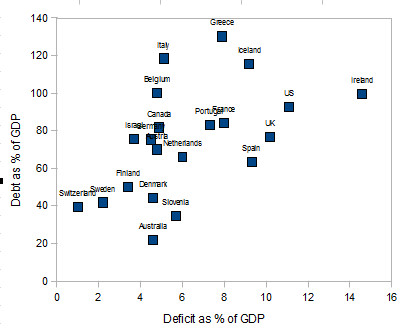
I like to use this picture, showing deficits and debt as of the end of 2010:

DESCRIPTIONIMF Fiscal Monitor

Source. I’ve used the 2009 deficit for Ireland, so as not to include the one-time costs of the bank bailout.

What you can see here is that the US and the UK look as if they should be in a similar category with the troubled European peripherals; and Japan is literally off the chart. But having our own currencies makes a big difference.

All I’m saying is that dollar or no dollar, fiscal solvency is still an issue — not now, not for some time to come, but not something we can always ignore.

μια εκδρομή


στη λίμνη Δόξας ...

Τετάρτη, Μαρτίου 23, 2011

Τρίτη, Μαρτίου 22, 2011

FUKUSHIMA ΑΓΑΠΗ ΜΟΥ


Lake Sohara Fukushima

What They're Covering Up at Fukushima

By HIROSE TAKASHI

Introduced by Douglas Lummis

Okinawa

Hirose Takashi has written a whole shelf full of books, mostly on the nuclear power industry and the military-industrial complex. Probably his best known book is Nuclear Power Plants for Tokyo in which he took the logic of the nuke promoters to its logical conclusion: if you are so sure that they're safe, why not build them in the center of the city, instead of hundreds of miles away where you lose half the electricity in the wires?

He did the TV interview that is partly translated below somewhat against his present impulses. I talked to him on the telephone today (March 22 , 2011) and he told me that while it made sense to oppose nuclear power back then, now that the disaster has begun he would just as soon remain silent, but the lies they are telling on the radio and TV are so gross that he cannot remain silent.

I have translated only about the first third of the interview (you can see the whole thing in Japanese on you-tube), the part that pertains particularly to what is happening at the Fukushima plants. In the latter part he talked about how dangerous radiation is in general, and also about the continuing danger of earthquakes.

After reading his account, you will wonder, why do they keep on sprinkling water on the reactors, rather than accept the sarcophagus solution [ie., entombing the reactors in concrete. Editors.] I think there are a couple of answers. One, those reactors were expensive, and they just can't bear the idea of that huge a financial loss. But more importantly, accepting the sarcophagus solution means admitting that they were wrong, and that they couldn't fix the things. On the one hand that's too much guilt for a human being to bear. On the other, it means the defeat of the nuclear energy idea, an idea they hold to with almost religious devotion. And it means not just the loss of those six (or ten) reactors, it means shutting down all the others as well, a financial catastrophe. If they can only get them cooled down and running again they can say, See, nuclear power isn't so dangerous after all. Fukushima is a drama with the whole world watching, that can end in the defeat or (in their frail, I think groundless, hope) victory for the nuclear industry. Hirose's account can help us to understand what the drama is about. Douglas Lummis

Hirose Takashi: The Fukushima Nuclear Power Plant Accident and the State of the Media

Broadcast by Asahi NewStar, 17 March, 20:00

Interviewers: Yo and Maeda Mari

Yo: Today many people saw water being sprayed on the reactors from the air and from the ground, but is this effective?

Hirose: . . . If you want to cool a reactor down with water, you have to circulate the water inside and carry the heat away, otherwise it has no meaning. So the only solution is to reconnect the electricity. Otherwise it’s like pouring water on lava.

Yo: Reconnect the electricity – that’s to restart the cooling system?

Hirose: Yes. The accident was caused by the fact that the tsunami flooded the emergency generators and carried away their fuel tanks. If that isn’t fixed, there’s no way to recover from this accident.

Yo: Tepco [Tokyo Electric Power Company, owner/operator of the nuclear plants] says they expect to bring in a high voltage line this evening.

Hirose: Yes, there’s a little bit of hope there. But what’s worrisome is that a nuclear reactor is not like what the schematic pictures show (shows a graphic picture of a reactor, like those used on TV). This is just a cartoon. Here’s what it looks like underneath a reactor container (shows a photograph). This is the butt end of the reactor. Take a look. It’s a forest of switch levers and wires and pipes. On television these pseudo-scholars come on and give us simple explanations, but they know nothing, those college professors. Only the engineers know. This is where water has been poured in. This maze of pipes is enough to make you dizzy. Its structure is too wildly complex for us to understand. For a week now they have been pouring water through there. And it’s salt water, right? You pour salt water on a hot kiln and what do you think happens? You get salt. The salt will get into all these valves and cause them to freeze. They won’t move. This will be happening everywhere. So I can’t believe that it’s just a simple matter of you reconnecting the electricity and the water will begin to circulate. I think any engineer with a little imagination can understand this. You take a system as unbelievably complex as this and then actually dump water on it from a helicopter – maybe they have some idea of how this could work, but I can’t understand it.

Yo: It will take 1300 tons of water to fill the pools that contain the spent fuel rods in reactors 3 and 4. This morning 30 tons. Then the Self Defense Forces are to hose in another 30 tons from five trucks. That’s nowhere near enough, they have to keep it up. Is this squirting of water from hoses going to change the situation?

Hirose: In principle, it can’t. Because even when a reactor is in good shape, it requires constant control to keep the temperature down to where it is barely safe. Now it’s a complete mess inside, and when I think of the 50 remaining operators, it brings tears to my eyes. I assume they have been exposed to very large amounts of radiation, and that they have accepted that they face death by staying there. And how long can they last? I mean, physically. That’s what the situation has come to now. When I see these accounts on television, I want to tell them, “If that’s what you say, then go there and do it yourself!” Really, they talk this nonsense, trying to reassure everyone, trying to avoid panic. What we need now is a proper panic. Because the situation has come to the point where the danger is real.

If I were Prime Minister Kan, I would order them to do what the Soviet Union did when the Chernobyl reactor blew up, the sarcophagus solution, bury the whole thing under cement, put every cement company in Japan to work, and dump cement over it from the sky. Because you have to assume the worst case. Why? Because in Fukushima there is the Daiichi Plant with six reactors and the Daini Plant with four for a total of ten reactors. If even one of them develops the worst case, then the workers there must either evacuate the site or stay on and collapse. So if, for example, one of the reactors at Daiichi goes down, the other five are only a matter of time. We can’t know in what order they will go, but certainly all of them will go. And if that happens, Daini isn’t so far away, so probably the reactors there will also go down. Because I assume that workers will not be able to stay there.

I’m speaking of the worst case, but the probability is not low. This is the danger that the world is watching. Only in Japan is it being hidden. As you know, of the six reactors at Daiichi, four are in a crisis state. So even if at one everything goes well and water circulation is restored, the other three could still go down. Four are in crisis, and for all four to be 100 per cent repaired, I hate to say it, but I am pessimistic. If so, then to save the people, we have to think about some way to reduce the radiation leakage to the lowest level possible. Not by spraying water from hoses, like sprinkling water on a desert. We have to think of all six going down, and the possibility of that happening is not low. Everyone knows how long it takes a typhoon to pass over Japan; it generally takes about a week. That is, with a wind speed of two meters per second, it could take about five days for all of Japan to be covered with radiation. We’re not talking about distances of 20 kilometers or 30 kilometers or 100 kilometers. It means of course Tokyo, Osaka. That’s how fast a radioactive cloud could spread. Of course it would depend on the weather; we can’t know in advance how the radiation would be distributed. It would be nice if the wind would blow toward the sea, but it doesn’t always do that. Two days ago, on the 15th, it was blowing toward Tokyo. That’s how it is. . . .

Yo: Every day the local government is measuring the radioactivity. All the television stations are saying that while radiation is rising, it is still not high enough to be a danger to health. They compare it to a stomach x-ray, or if it goes up, to a CT scan. What is the truth of the matter?

Hirose: For example, yesterday. Around Fukushima Daiichi Station they measured 400 millisieverts – that’s per hour. With this measurement (Chief Cabinet Secretary) Edano admitted for the first time that there was a danger to health, but he didn’t explain what this means. All of the information media are at fault here I think. They are saying stupid things like, why, we are exposed to radiation all the time in our daily life, we get radiation from outer space. But that’s one millisievert per year. A year has 365 days, a day has 24 hours; multiply 365 by 24, you get 8760. Multiply the 400 millisieverts by that, you get 3,500,000 the normal dose. You call that safe? And what media have reported this? None. They compare it to a CT scan, which is over in an instant; that has nothing to do with it. The reason radioactivity can be measured is that radioactive material is escaping. What is dangerous is when that material enters your body and irradiates it from inside. These industry-mouthpiece scholars come on TV and what to they say? They say as you move away the radiation is reduced in inverse ratio to the square of the distance. I want to say the reverse. Internal irradiation happens when radioactive material is ingested into the body. What happens? Say there is a nuclear particle one meter away from you. You breathe it in, it sticks inside your body; the distance between you and it is now at the micron level. One meter is 1000 millimeters, one micron is one thousandth of a millimeter. That’s a thousand times a thousand squared. That’s the real meaning of “inverse ratio of the square of the distance.” Radiation exposure is increased by a factor of a trillion. Inhaling even the tiniest particle, that’s the danger.

Yo: So making comparisons with X-rays and CT scans has no meaning. Because you can breathe in radioactive material.

Hirose: That’s right. When it enters your body, there’s no telling where it will go. The biggest danger is women, especially pregnant women, and little children. Now they’re talking about iodine and cesium, but that’s only part of it, they’re not using the proper detection instruments. What they call monitoring means only measuring the amount of radiation in the air. Their instruments don’t eat. What they measure has no connection with the amount of radioactive material. . . .

Yo: So damage from radioactive rays and damage from radioactive material are not the same.

Hirose: If you ask, are any radioactive rays from the Fukushima Nuclear Station here in this studio, the answer will be no. But radioactive particles are carried here by the air. When the core begins to melt down, elements inside like iodine turn to gas. It rises to the top, so if there is any crevice it escapes outside.

Yo: Is there any way to detect this?

Hirose: I was told by a newspaper reporter that now Tepco is not in shape even to do regular monitoring. They just take an occasional measurement, and that becomes the basis of Edano’s statements. You have to take constant measurements, but they are not able to do that. And you need to investigate just what is escaping, and how much. That requires very sophisticated measuring instruments. You can’t do it just by keeping a monitoring post. It’s no good just to measure the level of radiation in the air. Whiz in by car, take a measurement, it’s high, it’s low – that’s not the point. We need to know what kind of radioactive materials are escaping, and where they are going – they don’t have a system in place for doing that now.

Δευτέρα, Μαρτίου 21, 2011

το είδες?

lovely

Η επιστροφή του Matthew

το νέο αριστούργημα του Frank Gehry στη Νέα Υόρκη


more :

New York by Gehry at 8 Spruce Street

η ιστορία επαναλαμβάνεται


Tokyo Postcard

History Repeats
by Kenzaburo Oe

March 28, 2011


By chance, the day before the earthquake, I wrote an article, which was published a few days later, in the morning edition of the Asahi Shimbun. The article was about a fisherman of my generation who had been exposed to radiation in 1954, during the hydrogen-bomb testing at Bikini Atoll. I first heard about him when I was nineteen. Later, he devoted his life to denouncing the myth of nuclear deterrence and the arrogance of those who advocated it. Was it a kind of sombre foreboding that led me to evoke that fisherman on the eve of the catastrophe? He has also fought against nuclear power plants and the risk that they pose. I have long contemplated the idea of looking at recent Japanese history through the prism of three groups of people: those who died in the bombings of Hiroshima and Nagasaki, those who were exposed to the Bikini tests, and the victims of accidents at nuclear facilities. If you consider Japanese history through these stories, the tragedy is self-evident. Today, we can confirm that the risk of nuclear reactors has become a reality. However this unfolding disaster ends—and with all the respect I feel for the human effort deployed to contain it—its significance is not the least bit ambiguous: Japanese history has entered a new phase, and once again we must look at things through the eyes of the victims of nuclear power, of the men and the women who have proved their courage through suffering. The lesson that we learn from the current disaster will depend on whether those who survive it resolve not to repeat their mistakes.

This disaster unites, in a dramatic way, two phenomena: Japan’s vulnerability to earthquakes and the risk presented by nuclear energy. The first is a reality that this country has had to face since the dawn of time. The second, which may turn out to be even more catastrophic than the earthquake and the tsunami, is the work of man. What did Japan learn from the tragedy of Hiroshima? One of the great figures of contemporary Japanese thought, Shuichi Kato, who died in 2008, speaking of atomic bombs and nuclear reactors, recalled a line from “The Pillow Book,” written a thousand years ago by a woman, Sei Shonagon, in which the author evokes “something that seems very far away but is, in fact, very close.” Nuclear disaster seems a distant hypothesis, improbable; the prospect of it is, however, always with us. The Japanese should not be thinking of nuclear energy in terms of industrial productivity; they should not draw from the tragedy of Hiroshima a “recipe” for growth. Like earthquakes, tsunamis, and other natural calamities, the experience of Hiroshima should be etched into human memory: it was even more dramatic a catastrophe than those natural disasters precisely because it was man-made. To repeat the error by exhibiting, through the construction of nuclear reactors, the same disrespect for human life is the worst possible betrayal of the memory of Hiroshima’s victims.

I was ten years old when Japan was defeated. The following year, the new Constitution was proclaimed. For years afterward, I kept asking myself whether the pacifism written into our Constitution, which included the renunciation of the use of force, and, later, the Three Non-Nuclear Principles (don’t possess, manufacture, or introduce into Japanese territory nuclear weapons) were an accurate representation of the fundamental ideals of postwar Japan. As it happens, Japan has progressively reconstituted its military force, and secret accords made in the nineteen-sixties allowed the United States to introduce nuclear weapons into the archipelago, thereby rendering those three official principles meaningless. The ideals of postwar humanity, however, have not been entirely forgotten. The dead, watching over us, oblige us to respect those ideals, and their memory prevents us from minimizing the pernicious nature of nuclear weaponry in the name of political realism. We are opposed. Therein lies the ambiguity of contemporary Japan: it is a pacifist nation sheltering under the American nuclear umbrella. One hopes that the accident at the Fukushima facility will allow the Japanese to reconnect with the victims of Hiroshima and Nagasaki, to recognize the danger of nuclear power, and to put an end to the illusion of the efficacy of deterrence that is advocated by nuclear powers.

When I was at an age that is commonly considered mature, I wrote a novel called “Teach Us to Outgrow Our Madness.” Now, in the final stage of life, I am writing a “last novel.” If I manage to outgrow this current madness, the book that I write will open with the last line of Dante’s Inferno: “And then we came out to see once more the stars.”

Το πιο γελοίο με τον Πάγκαλο


είναι ότι πιστεύει ή κάνει ότι πιστεύει ότι μόνο ο ΣΥΡΙΖΑ τα έχει μαζί του

δηλαδή τα υπόλοιπα κόμματα ΝΔ, ΚΚΕ, ΛΑΟΣ, Οικολόγοι ακόμα και το ΠΑΣΟΚ τον χειροκροτούν και μόνο ο ΣΥΡΙΖΑ τον γιαουρτώνει και τον αποδοκιμάζει

με λίγα λόγια το διαζύγιο του Πάγκαλου με την πραγματικότητα είναι οριστικό και αμετάκλητο


...

ΤΡΑΒΑ ΕΜΠΡΟΣ ΔΙΣ ΚΑΤΕΧΑΚΗ