MICHAEL HUDSON
Banks Weren’t Meant to Be Like This
MIKE WHITNEY
Draghi’s 489 Billion Euro Fakery
...
Δευτέρα, Ιανουαρίου 30, 2012

Κυριακή, Ιανουαρίου 29, 2012

Παρασκευή, Ιανουαρίου 27, 2012

Τετάρτη, Ιανουαρίου 25, 2012

το αγόρι της Lacta
πρωταγωνιστεί στην τηλεοπτική μεταφορά του βιβλίου Christopher and His Kind, του Christopher Isherwood
Τρίτη, Ιανουαρίου 24, 2012

Δευτέρα, Ιανουαρίου 23, 2012
οικονομολόγοι για τα μπάζα
How Austerity Is Killing Europe
Jeff Madrick

The European Union has become a vicious circle of burgeoning debt leading to radical austerity measures, which in turn further weaken economic conditions and result in calls for still more damaging cuts in government spending and higher taxes. Rarely do we get so stark an example of bad—arguably even perverse—economic thinking in action. How could the EU so misread history and treat with contempt the teachings of John Maynard Keynes, who showed that during recessions governments must expand economies through spending and tax cuts, not the opposite? By ignoring this, European policy makers will deepen, not solve, the financial crisis and millions of people will suffer needlessly.
...
Κυριακή, Ιανουαρίου 22, 2012


Παρασκευή, Ιανουαρίου 20, 2012

Πέμπτη, Ιανουαρίου 19, 2012
με μια ψόφια γάτα στο κεφάλι

When bad wigs, bad Photoshop and bad sex posing happens to good people.

Τρίτη, Ιανουαρίου 17, 2012
the art of Stanley Spencer
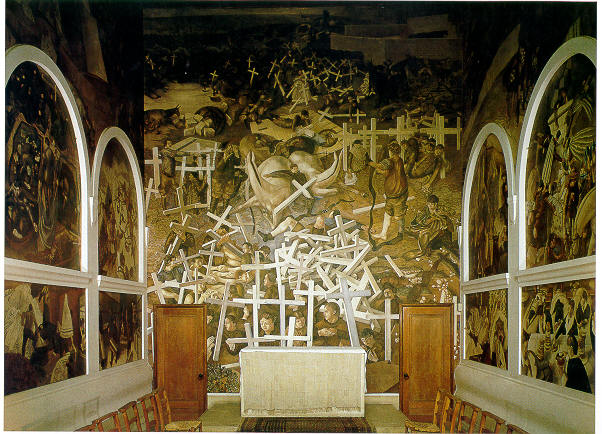
In The Art of War, Jon Snow was most visibly moved when visiting the Sandham Memorial Chapel at Burghclere in Hampshire, which is decorated with an outstanding series of large-scale paintings by Stanley Spencer (above). The images were inspired by his experiences as a First World War medical orderly and soldier in Macedonia, and are considered to be among his finest achievements.
The chapel was commissioned by Mary and Louis Behrends as a memorial to Mary’s brother, who died in Macedonia. The main painting, The Resurrection of the Soldiers (above), shows soldiers climbing out of their graves bearing white crosses and embracing their dead comrades. One man kneels at Christ’s side, his head in his lap, one man caresses a turtle, while another clasps a dove to his chest. Spencer wrote of the painting:
During the war, I felt the only way to end the ghastly experience would be if everyone suddenly decided to indulge in every degree or form of sexual love, carnal love, bestiality, anything you like to call it. These are the joyful inheritances of mankind.
In his film, Snow said:
Had his paintings been for a Wren church in the city, Spencer might even now be celebrated as the creator of our own Sistine Chapel. From the outside, the Sandham Memorial Chapel is unremarkable. Step inside and you are drawn into an account of war no artist has ever previously conjured.

αν έχεις τον χρόνο
Eurozone Busily Decimating Member Countries | |
By: David Dayen Monday January 16, 2012 6:17 am | |
When Standard and Poor’s downgraded nine European countries last Friday, they said plainly that European leaders were blinding themselves to the full crisis:
We also believe that the agreement [the latest euro rescue plan] is predicated on only a partial recognition of the source of the crisis: that the current financial turmoil stems primarily from fiscal profligacy at the periphery of the eurozone. In our view, however, the financial problems facing the eurozone are as much a consequence of rising external imbalances and divergences in competitiveness between the EMU’s core and the so-called “periphery”. As such, we believe that a reform process based on a pillar of fiscal austerity alone risks becoming self-defeating, as domestic demand falls in line with consumers’ rising concerns about job security and disposable incomes, eroding national tax revenues.
Right after that, German Chancellor Angela Merkel stressed the need to implement fiscal straitjackets quickly in the wake of the downgrade. It’s like nobody even read the S&P report. And nowhere is this more true than Greece, where poverty has risen almost to the level to call the situation an humanitarian disaster, but where European leaders still strive for more “reform”, the equivalent of giving the patient more poison and wondering why they just get sicker. Now they plan to kill the patient outright.
Officials from the so-called troika of foreign lenders to Greece — the European Central Bank, European Union and International Monetary Fund — have come to believe that the country has neither the ability nor the will to carry out the broad economic reforms it has promised in exchange for aid, people familiar with the talks say, and they say they are even prepared to withhold the next installment of aid in March [...]
As recently as November, Greece and its lenders were optimistic that the country’s newly installed prime minister, Lucas Papademos, a well-respected financial technocrat, would stabilize Greece’s soaring debt and help nurse the country back to health.
But since then, his interim government — stocked not with technocrats but with politicians gunning for national elections as soon as March — has been paralyzed. Although it passed the 2012 national budget, it has failed to put into effect most of the unpopular changes mandated by the loan agreement that the previous government made back in 2010, when the country first admitted it was broke.
Yes, it’s amazing Papademos can’t get this done, right? It’s like giving a lumberjack a plastic spoon and wondering why he hasn’t clear-cut the forest yet. Austerity has become self-defeating, whether you call it what it is, or “reform.” Either way, it’s destroying Greece, and mere technocratic leadership won’t solve the problem.
Talks between Greece and its creditors will resume this week. The problem, as I understand it, is that Greek debt has been bought up by hedge funds [and other creditors with default insurance they believe will pay off] and they are playing a game of chicken to recoup the full [or larger] amount for the debt. Greece is simply too weak to have leverage here, since the hedgies are really negotiating by proxy with the EU and ECB and IMF, on the idea that an uncontrolled default is so undesirable that the troika will pay them off at par. So I see nothing coming out of the first level of negotiations unless the troika gets involved.
The European mess will dominate the economic picture until the horrible policy from Europe’s leaders reverses itself.
Δευτέρα, Ιανουαρίου 16, 2012
στο χείλος
What Gives
The awesome exertions of the global banking system to evade the mandates of reality finally yield in a sickening slippage to epochal unwind. What a bad idea: to try to juke nature itself. In case you weren't paying attention over the weekend - and who really wants to? - the cosmic Brinks truck of free money went over a cliff, and the darn thing will keep free-falling until (at least) the American markets open again on Tuesday.
So, everybody and his uncle over in Europe got a sovereign debt downgrade and now the math changes for all the pretend bail-outs and back-stops that had been so exquisitely rigged through the long, nauseating autumn. Math is an annoying representation of reality, but hard to argue with. Bail-outs and back-stops finally became unaffordable even as poetic constructs.
Thus, we also approach the dreaded inflection point for the credit default swaps. Nobody believes that this Mount Everest of jive bond "insurance" can actually pay out, since the first instance of any attempt will bankrupt everybody. And yet there are the holders of all that paper who will object to, say, an 80 percent haircut on their Greek (and other) bonds. Surely some of them will try to invoke their CDS contracts. What then? Three possibilities that I see: 1) all parties and counter-parties go down the drain faster than you can say Benedict Cumberbatch; 2) all parties declare in unison that CDS were a prank that should now just be ignored, as if the cast ofDownton Abbey showed up naked at the dinner table; and 3) every sort of loan on God's Green Earth is instantly re-priced and the entire world turns into a flea market. How will America do with its stock of slightly pre-owned Dunkin' Donuts stores, a million-odd Elvis lunch-boxes, and all those old videos ofFriends? Don't you wish you'd invested in some hand tools?

Κυριακή, Ιανουαρίου 15, 2012

Σάββατο, Ιανουαρίου 14, 2012

Παρασκευή, Ιανουαρίου 13, 2012
huston we ve got a problem. Again!
Satyajit Das: Europe’s The Road to Nowhere, Part 1 – Fiscal Bondage
Yves here. As much as the image of Frau Merkel decked out as a domme is more than my tender sensibilities can take, the metaphor seems to apt for writers like Das to pass it by.
By Satyajit Das, derivatives expert and the author of Extreme Money: The Masters of the Universe and the Cult of Risk Traders, Guns & Money: Knowns and Unknowns in the Dazzling World of Derivatives – Revised Edition (2006 and 2010)
Financially futile, economically erroneous, politically puzzling and socially irresponsible, the December 2011 European summit was a failure. Only the attending leaders and their acolytes believe otherwise. German Chancellor Angela Merkel’s post-summit homilies about the “long run”, “running a marathon” and “more Europe” rang hollow.
The proposed plan is fundamentally flawed. It made no attempt to tackle the real issues – the level of debt, how to reduce it, how to meet funding requirements or how to restore growth. Most importantly there were no new funds committed to the exercise.
Fiscal Bondage…
The centrepiece of the new plan was a commitment to a new legally enforceable “fiscal compact” requiring government budgets to be balanced or in surplus, with the annual structural deficit not to exceed 0.5% of nominal Gross Domestic Product (“GDP”).
The language was Orwellian and incomprehensible in equal measure: “Member States shall converge towards their specific reference level, according to a calendar proposed by the Commission.” The European Commission is to approve national budgets with, curiously, the European Court of Justice designated as final arbiter.
Whatever the long-term merit of greater budget discipline, the compact recycles previous Treaties, which have been honoured in the breach rather than observance. Since 1999 or from the time of their entry, Euro-Zone member countries have recorded nearly 70 breaches of the existing Stability and Growth Pact, including nearly 30 occasions when budget deficits exceeding 3% of GDP were allowed because of recessions. Germany and France have been in breach on at least 6 occasions each.
Just as Margaret Thatcher favoured “sado monetarism” (a term coined by Denis Healey), the German plan for Europe is “fiscal B&D” (bondage and discipline).
The plan may result in a further slowdown in growth in Europe, worsening public finances and increasing pressure on credit ratings. This is precisely the experience of Greece, Ireland, Portugal and Britain as they have tried to reduce budget deficits through austerity programs. This would make the existing debt burden even harder to sustain. The rigidity of the rules also limits government policy flexibility, risking making economic downturns worse.
Δευτέρα, Ιανουαρίου 09, 2012
Inferno

Είμαι έτοιμος να εκραγώ. Αν ακούσω ακόμα μία φορά το τεχνοκρατικό ρομπότ που μας κυβερνάει να μιλάει για κόκκινες γραμμές ούτε καν θέλω να φανταστώ που είμαι ικανός να φτάσω.
Ζω έναν εφιάλτη. Γύρω μου γίνεται ένας πόλεμος και οι συμπολίτες μου πιστεύουν [στα σοβαρά] ότι δεν ξεσηκώνονται επειδή τους ... ψεκάζουν.
Καθημερινά με χίλιους δυο τρόπους μας καταδικάζουν στην εξαθλίωση κι εμείς σφυρίζουμε κλέφτικα, επειδή ακόμα και η σκέψη ότι θα πρέπει να βάλουμε τα δύο τελευταία εγκεφαλικά κύτταρα που μας έχουν απομείνει να δουλέψουν προκειμένου να δούμε τι θα κάνουμε για να προστατευτούμε από τη λαίλαπα μας κουράζει.
Εκτός από τρόικα χρειάζονται και θύματα με μυαλά πουρέ για να επιβληθούν όσα επιβάλλονται στον τόπο μας τα τελευταία χρόνια.
Σαν ναρκομανείς περιμένουμε την επόμενη δόση μέχρι την τελευταία υπερβολική δόση που μας μας στείλει αδιάβαστους στον αγύριστο της χρεοκοπίας.
Το εισόδημά μου έχει μειωθεί κατά 40% τον τελευταίο χρόνο και τώρα λένε θα το μειώσουν κι άλλο καταργώντας τον 13ο και 14ο μισθό. Μοναδική προοπτική που μου προτείνουν είναι να μειωθεί κι άλλο. Μέσα σε λίγο χρονικό διάστημα η γενιά των 700 ευρώ έγινε η κοινωνία των 300.
Εν τω μεταξύ τεχνοκράτες, ηγέτες και πράσινα άλογα επιβάλλουν τη μία καταστροφική λύση μετά την άλλη, λύσεις που υπαγορεύονται από αυτούς τους ίδιους που δημιούργησαν την κρίση - τις τράπεζες και τους τεχνοκράτες εκπροσώπους τους.
Υπάρχει κανείς που να έχει μείνει ξύπνιος;
...
Δευτέρα, Ιανουαρίου 02, 2012

here we go again
Austerity Reigns Over Euro Zone as Crisis Deepens
By NELSON D. SCHWARTZ
European economies are braced for a turbulent year, as widening deficits force more borrowing and growth moves further out of reach.


Εγγραφή σε:
Αναρτήσεις (Atom)